




By: Gloria Fuson
“When I was writing it, I wanted something celebratory—something that brought my age into the conversation in a positive way… I’m proud of it. I enjoy getting older,” Sophie Ellis-Bextor shared in an interview with Clash Magazine while presenting her album Perimenopop.
The “Murder on the Dance Floor” sensation returned in September 2025 with an album named not to dissect perimenopause itself (I’ve personally checked every lyric for a reference I was, not going to lie, keen to find—there are none!), but as a sly nod to the ageism and sexism women face in the industry once they reach this stage of life. Essentially, it’s a 12-song refusal to disappear quietly into the midst.
Speaking to Music Week, Ellis-Bextor noted: “I’ve felt, and I know my peers have felt, that you get to a point where all the algorithms start shifting towards perimenopause. It can feel a bit gloomy, looking at these ideas of what lies ahead.”
There’s a striking irony here. That exact algorithmic shift is why so many women — myself included — recently stumbled across a viral Allure Instagram clip.
In it, Olivia Wilde and Penélope Cruz discuss their film The Invite. During the interview, Cruz casually mentioned her unscripted decision to write perimenopause into a scene. As she explained to Entertainment Weekly, if her character, a therapist and sexologist whose entire identity centers on discussing intimacy candidly, was going to talk about sex, she had to talk about perimenopause, too. Anything less wouldn’t be credible.
The clip went semi-viral for reasons that speak volumes about the current state of women’s health.
In the comment section, women were frantically recounting years of unexplained symptoms. One called frozen shoulder “the worst” and received hundreds of likes; another shared that she suffered from it at 39 with nobody suggesting perimenopause as a cause. (Side note: when the film premiered at the 2026 Sundance Film Festival, it earned a standing ovation — just in case you needed another reason to watch).
The questions women are asking, the confusion between general “aging” and “hormonal transition,” and the reality that we are taught everything about avoiding pregnancy and virtually nothing about what comes after it are fueling a movement. Women are increasingly choosing to name this experience themselves rather than waiting for society to do it for them.

But What Is Perimenopause, Really?
According to Maisie Hill, author of Perimenopause Power (the follow-up to her 2019 cycle bible, Period Power): “Perimenopause is when we are faced with ourselves and confronted with the reality of our lives. Then we get to decide what we want to keep and what we want to do away with.” Hill likens this stage to a snake shedding the skin of the “estrogen years”— letting go of life-long people-pleasing tendencies and reclaiming whatever actually serves us. Reading her book back when it was published in 2021 was eye-opening; if we are only just starting to break this taboo now, you can imagine how radical it was then.
Dr. Mary Claire Haver, the American OB-GYN and menopause advocate (who, interestingly, is the person who taught Penélope Cruz about perimenopausal frozen shoulder in the first place), writes on her Substack: “Perimenopause is the transition from a hormonally stable reproductive cycle to one marked by wild fluctuation. It is not linear, not gentle, and rarely discussed.”
That lack of linearity explains why this transition is so notoriously difficult, and why what works wonders for a celebrity or your next-door neighbor might be completely useless for you. To make matters worse, medical systems have historically left women in the dark.
As Dr. Haver wrote on her blog: “Due to lack of training and education of medical clinicians in perimenopause, patients’ experiences are often dismissed, and we are left questioning our sanity or feeling gaslit.”
In an interview with Flow Space, Dr. Haver admitted she received zero dedicated clinical training in menopause during her OB-GYN residency. She was never taught to connect hormonal shifts to a patient’s mental health, brain fog, or heart palpitations. It’s no wonder so many women struggle to find answers or proper care, whether allopathic, holistic, or therapeutic.
But change is happening.
As Dr. Haver put it: “I was a terrible menopause provider for most of my career… but not anymore.” That is the exact transformation we need from the broader medical community.
Reclaiming Our Biology
It’s wonderful when celebrities use their platforms to break taboos, and when doctors use social media to cut through the noise. But what can the rest of us do?
Personally and professionally, I believe it starts with making peace with our biology. It’s easy to look at male biology with a bit of envy and view our own complex systems as a curse — trust me, I get it. But resenting our bodies won’t change them.
We can start by educating ourselves, understanding what is actually happening internally, and preparing for what’s next. We routinely educate ourselves on pregnancy and postpartum care; it only makes sense to extend that same preparation to perimenopause and menopause.
We could also stand to be a little kinder to ourselves. Our biology asks a lot of our bodies; the bare minimum we can do is acknowledge that effort.
When we do need external support, reliable resources exist:
- The Menopause Society (US)
- The British Menopause Society (UK)
- Società Italiana Menopausa / SIM (Italy)
All three offer directories of certified specialists. Consulting a professional is crucial because perimenopause symptoms frequently overlap with other health issues, including autoimmune conditions and cardiovascular events. Ruling out underlying medical issues can be life-saving. As Dr. Nanette Santoro, a gynecologist and researcher at the University of Colorado, noted on NPR, testing hormone levels can often yield misleading results because hormones fluctuate wildly month-to-month. A good provider will focus on the broader picture rather than relying solely on a single lab panel.
Modern Life vs. Hormonal Health
This brings up a question I hear constantly: Are we suffering more now than previous generations did? Is menopause more complicated today, or are we just talking about it more? Is modern life damaging our hormonal health?
I spent time searching through studies on PubMed looking for clear answers. While research confirms that chronic stress, environmental exposures, and socioeconomic pressure correlate with increased symptom severity and earlier onset (as highlighted in a 2024 scoping review by Blackson et al. in BMC Women’s Health), there is no single study directly proving that modern life inherently ruins perimenopausal outcomes.
However, experts generally agree on key lifestyle factors. Late-night screen time disrupts melatonin production and our circadian rhythms, which negatively impacts overall and hormonal health.
Dr. Carrie Jones, an integrative hormone specialist, shared a perspective on social media that resonated deeply with me. Before blaming every symptom entirely on “our hormones,” she urged women to ask themselves:
- Are you sleeping enough?
- Are you managing your blood sugar?
- Are you eating enough overall nourishment and protein?
- Are you moving your body and lifting weights?
- Are you actively creating space for joy?
- Are you sending your nervous system signals that you are safe?
- Have you taken even 10 minutes of true solitude recently?
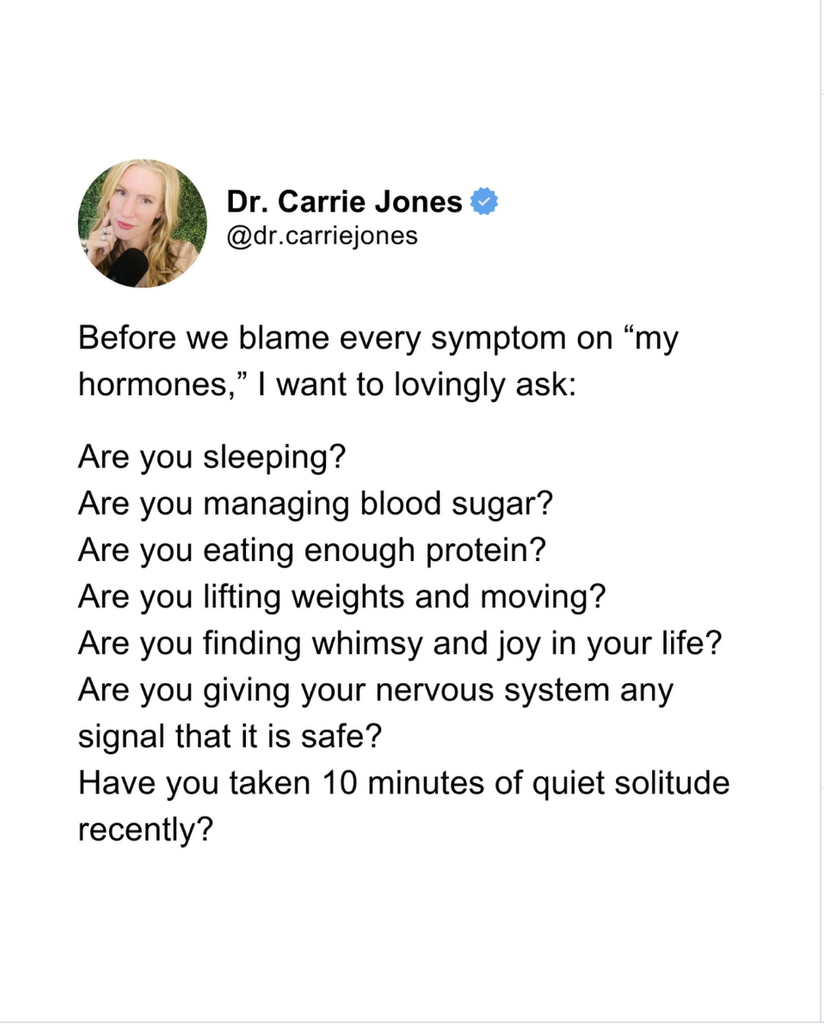
A single social media post can’t diagnose or cure anything, but it serves as a powerful reminder: sometimes our bodies are simply moving through a natural physiological transition, one that can be made significantly harder by our environment, that needs to be supported by basic foundational health.
Life is complicated, and medical interventions are vital tools we should be grateful for. At the same time, we need to recognize that while perimenopause and menopause are inevitable physiological rites of passage, a stressful, joyless, and exhausted existence is not. Touchè.
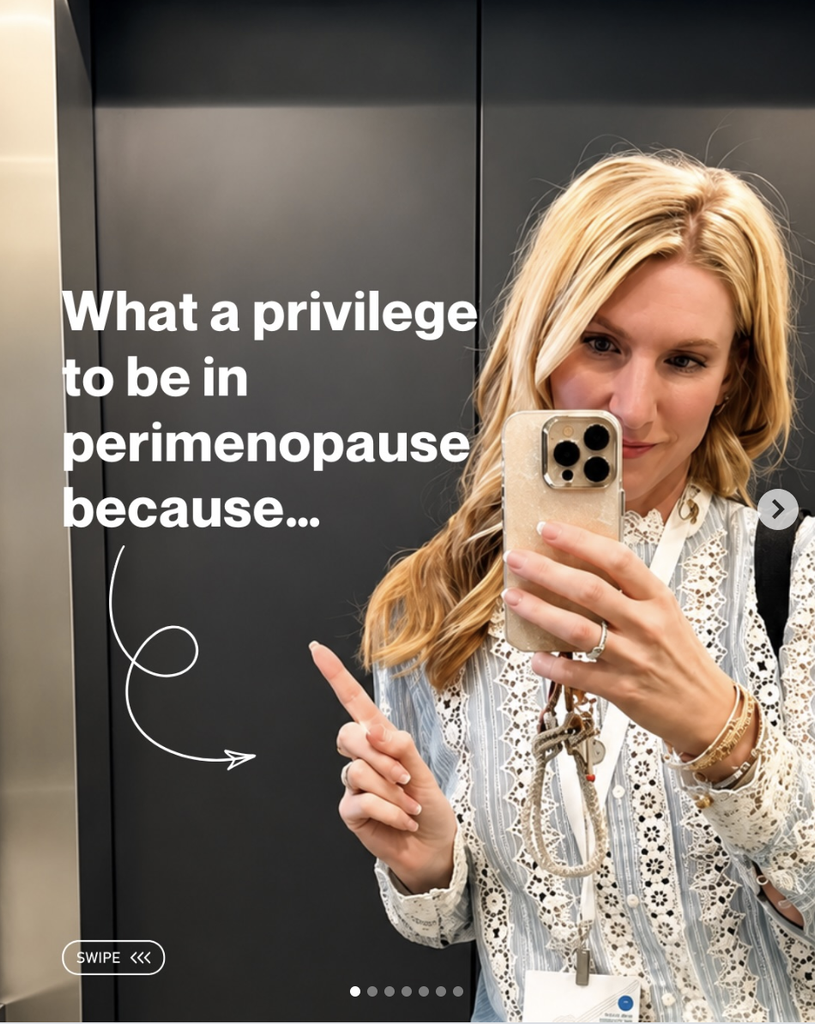
The problem isn’t always just our hormones.
We’ve been conditioned to put everything: partners, kids, careers, the emotional weight of an entire household, ahead of ourselves.
If this transition breaks anything, let it be that habit.
Think of perimenopause as a biological permission slip to stop asking for approval and finally put ourselves back on the agenda.
You can follow Gloria at her Substack here.



Read the Comments +